
Elections in Israel are Complicated!
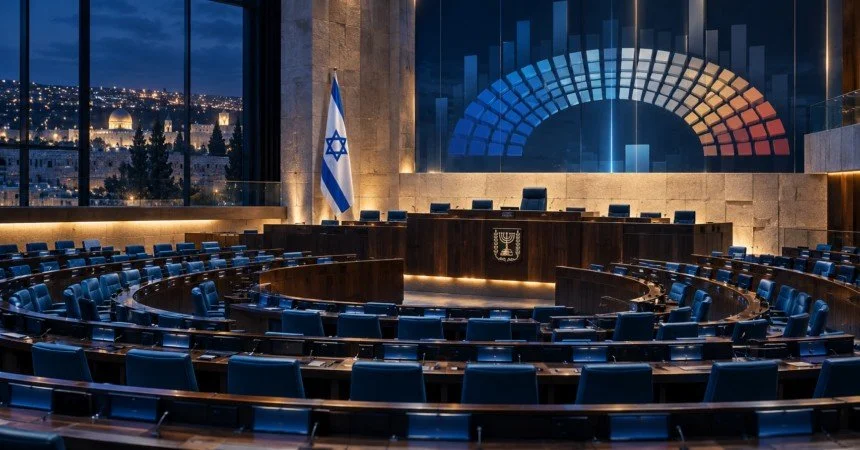
Israeli Knesset (Parliament)
Elections in Israel are done vastly different from the USA. First of all, people do not vote for a person—they vote for a party and the leader of the winning party becomes the Prime Minister. Israel has a multiparty system in which coalition governments are formed through negotiations among factions representing diverse ideological and religious constituencies. There are 120 seats in the Israeli Knesset (parliament) and a party needs to win 61 seats for a win. If no party achieves the 61 seats, the party with the highest seats is given six weeks to form a new government by going to the other parties to see if they would come into agreement with their policies.
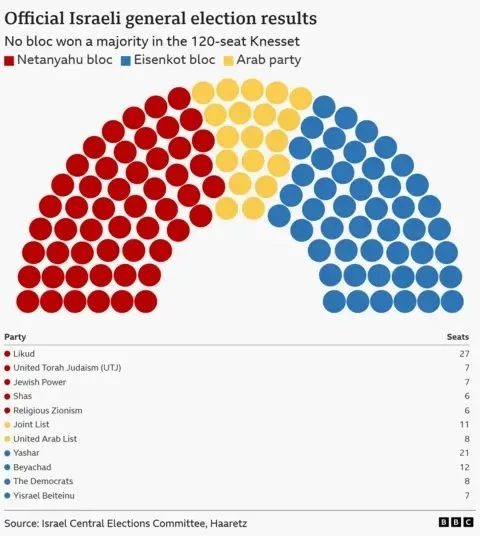
The elections that were held on October 27th proved that no one was able to achieve the 61-seat requirement. Prime Minister Benjamin Netanyahu (Likud party) attained the highest seats (27) and met with the leaders of the parties on the chart to the right in red. He was not successful in reaching the required 61 seats.
This week Gadi Eisenkot (Yashar party) is the politician that has now been tasked with forming a new Israeli government. On the chart, the parties he has combined are in blue. He pledged this week to reverse many of Prime Minister Benjamin Netanyahu’s policies as the new parliament was sworn in. Eisenkot has up to six weeks to form a government. No one can know if he will be able to turn the tables on the Israeli government; however, the new Knesset can enact legislation in the meantime. Netanyahu’s opponents now control a solid majority in Parliament.
The Arab parties were significantly larger in this election than in the past (yellow seats on the chart). In order for either leader to form their government, they would need to include the Arab bloc.
Current Prime Minister Netanyahu stated that Arab politicians, who represent a minority comprising 20% of Israel’s population, cannot be trusted. The opposition leaders appear to be willing to partner with the Arab parties to help Eisenkot form his government. Without that, there would be a draw and likely there would be another election in April.
Please take some time to pray over these Israeli elections. Who does God want in authority to lead Israel in these turbulent times? How will this leader affect the citizens in the Holy Land? How will he influence and interact with other world leaders?
“Therefore, I exhort first of all that supplications, prayers, intercessions, and giving of thanks be made for all men, for kings and all who are in authority, that we may lead a quiet and peaceable life in all godliness and reverence. For this is good and acceptable in the sight of God our Savior, who desires all men to be saved and to come to the knowledge of the truth. “ (I Timothy 2:1-2)